Projects · Naming Infrastructure
A blockchain address is easy for software to process and awkward for a person to recognize. Ethereum Name Service (ENS) tackles that gap by connecting readable names to the information applications need. Its most interesting feature is what happens after a name leaves the registration screen.
One name, several kinds of information
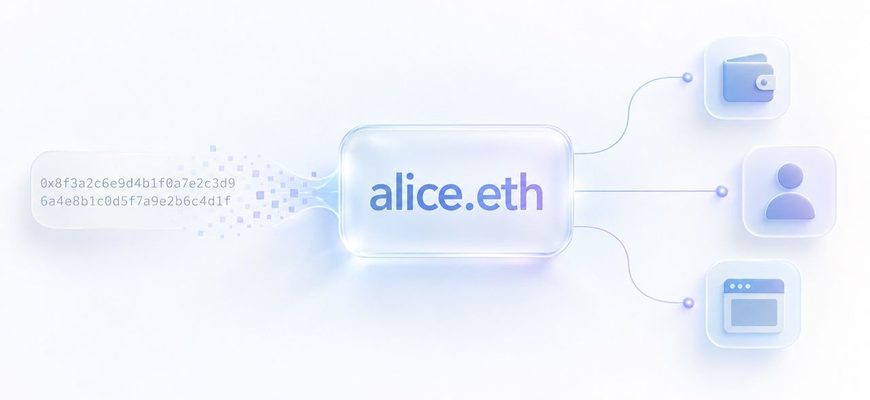
ENS is an open naming system built on Ethereum. A name such as alice.eth can resolve to an Ethereum address, an address for another cryptocurrency, a content hash, or metadata. It is a reference applications can look up, rather than simply a shorter string to paste into a wallet.
The namespace is hierarchical. Someone controlling a parent name can configure subnames: pay.alice.eth, for example, could serve a different purpose from the parent. ENS also supports importing compatible DNS names through DNSSEC, connecting existing web domains with its naming system. These capabilities are described in the official protocol overview.
How an application reads a name
The useful distinction is between controlling a name and deciding what information it returns. A resolver supplies the records an application asks for. In the documented lookup process, an application finds the resolver through the registry, then queries it for the relevant record. That might be an address, text information, or a content hash.
| Lookup | What it provides |
|---|---|
| Name → address | A destination associated with the name |
| Name → text records | Profile information, such as a GitHub handle |
| Address → primary name | A readable label for an address |
Forward resolution reads information from a name. Reverse resolution finds the primary name associated with an address. The ENS resolution overview explains both paths and the profile records they can expose.
A readable label still needs verification
Reverse lookup has a specific validation requirement. After finding a name for an address, the client must resolve that name forward and check that it points back to the original address. If it does not, ENS documentation instructs the application to display the address instead. The developer resolution guide makes this requirement explicit.
The practical implication is straightforward: a polished display name should not replace the underlying verification step. For a product team, the quality of an ENS integration includes how it handles missing records and failed checks, as well as how attractive the successful lookup looks.
The project is larger than its app
ENS Labs distinguishes the protocol from its registration app, namespace, and surrounding interfaces. Shared contracts and standards let independent products read the same naming information. A name can therefore be useful beyond the interface where someone first configured it. ENS Labs explains that architecture in “What Makes ENS a Protocol.”
Our reading is that ENS is a useful case study in crypto infrastructure becoming a product feature. Its value appears at the moment someone recognizes a recipient, understands an activity feed, or carries a profile into another compatible application.
That also gives the project a concrete test. A memorable name matters only when the software people actually use can interpret it consistently. For developers evaluating ENS, the questions are practical: which records does the application support, how does it verify the primary name, and what does the user see when resolution fails?
ENS makes an abstract infrastructure problem visible in a familiar interface element: the name. That is why it deserves attention as a project, even for readers who never plan to trade a domain.